
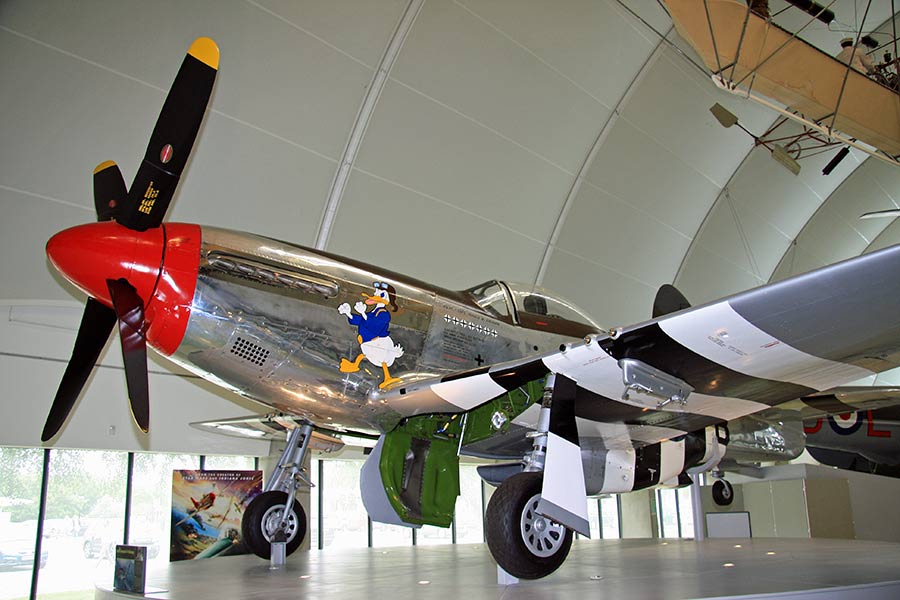
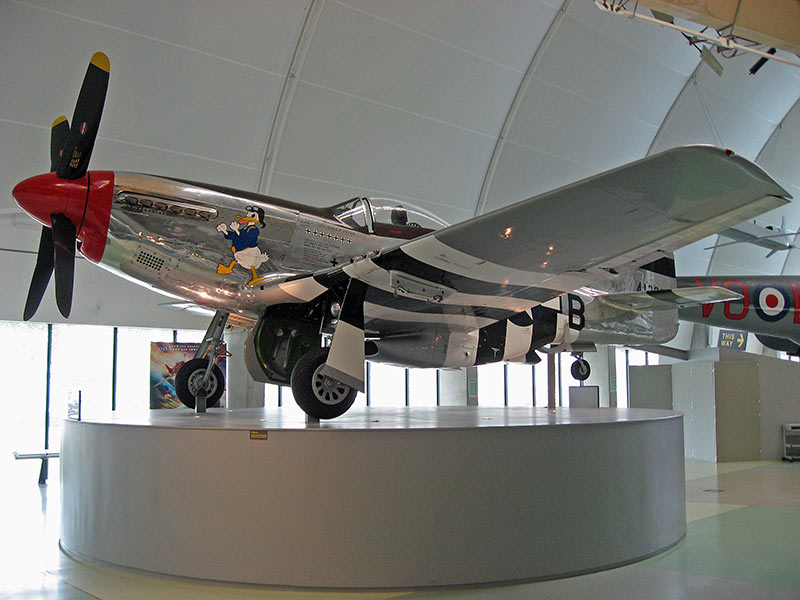
North American P-51D Mustang (44-74409) [@ RAF Hendon]
The North American P-51 Mustang was initially produced in
response to a 1940 RAF requirement for a fast, heavily armed fighter able to
operate effectively at altitudes in excess of 6100m (20,000ft). North American
built the prototype in 117 days and the aircraft, designated NA-73X, flew on 26th
October 1940. The first of 320 production Mustang Is for the RAF flew on 1st
May 1941, powered by an 1100 hp Allison V1710-39 engine. Due to their poor
performance at high-altitude the Allison powered Mustangs
(I, IA and II) were used for army co-operation, tactical reconnaissance
and low level attack, while the Merlin powered Mustangs
(III and IV) were used by Fighter Command as a straightforward fighter
aircraft.
In January 1942 the Mustang 1 (620 built) entered RAF service with 26 Squadron as a replacement for the Curtiss Tomahawk. At the time the squadron was flying a mix of Westland Lysander and its replacement the Tomahawk in the tactical reconnaissance role. On the 27th July 1942 16 RAF Mustangs undertook their first long-range reconnaissance mission over Germany. During the Dieppe Raid (later renamed Operation Jubilee), which took place on the northern coast of France on the 19th August 1942, four British and Canadian Mustang squadrons, including 26 Squadron, saw action.
44-74409 was built at Inglewood, California, and delivered to the 3rd
Air Force Unit of USAAF Air Training Command in 1945. Struck off Charge during
the mid-1950s and
then
assigned to the Royal Canadian Air Force as 9235. Entering RCAF service on the 6th
December 1950 44-74409 was first assigned to 417 Squadron (Central Air Command
Composite Flight, Trenton, Ontario) and then to 403 “City of Calgary”
Squadron
(Auxiliary)
which was based at Calgary. On the 23rd November 1953 44-74409
was transferred to 402 “City of Winnipeg” Squadron
(Auxiliary)
at Stevenson Field, Winnipeg, Manitoba. Placed into storage on the 31st
September 1954 and then after being Struck off Charge on the 30th
December 1958 44-74409 was sold on to the private market. Having had a large
number of owners both in Canada and the USA 44-74409 was donated to the RAF
Museum during 2003 and arrived in the UK on the 18th November 2003.
In the photograph 44-74409 is in the markings of Capt. Emerson. Donald Emerson
was from North Dakota and had chosen military service over farming. In England
he was assigned to the Eighth Air Force's elite Fourth Fighter Group on the 9th
March 1944. This premier fighting unit had been formed around the earlier "Eagle
Squadrons" of American pilots who voluntarily fought with the RAF before the
U.S. entered the war. On Christmas Day 1944, while flying a P.51 during the
Battle of the Bulge, Emerson was heading back to his base after a mission when
he encountered six enemy planes. He managed to shoot down two of them but as he
crossed enemy lines flying close to the ground he was struck by flak from
anti-aircraft guns. His plane crashed in British occupied territory in Belgium;
it is believed that he died before his plane landed. He was buried the next day
in a temporary military cemetery near Margraten, Holland, where his body is now
permanently interred in the American Military Cemetery. Capt. Donald R. Emerson
earned the Distinguished Flying Cross, the Air Medal (with additional clusters
awarded to both) and posthumously the Purple Heart. He was only 21.


North American P-51D Mustang (A68-192) [@ RAF Waddington]
The USAAF, somewhat belatedly, realised the fighter’s
potential and evaluated two early production Mustang Is under the designation
P-51. The first two USAAF Mustang variants, both optimised for ground attack and
designated A-36A and P-51A, were fitted with Allison engines. Trials with
Mustangs fitted with Packard built Rolls Royce Merlin 61 engines showed a
dramatic improvement in performance, maximum speed being raised from 390 mph to
441mph, and production of the Merlin powered P-51B got under way in the autumn
of 1942. The first RAF Mustangs diverted from American orders were 93 P-51s,
designated Mustang Mark IAs and these followed by 50
P-51As which were designated as Mustang IIs.
A68-192 was built for the Royal Australian Air Force (RAAF) by The Commonwealth
Aircraft Company and delivered to the RAAF on the 8th March 1951.
After just four hours of flying A68-192 was placed into storage and then Struck
off Charge during April 1958 at RAAF Tocumwal, New South Wales. Sold on to the
private market A68-192 remained in Australia until 1969 and was then shipped to
the Philippines. Unfortunately on the first test flight A68-192 suffered a heavy
forced landing due to engine failure. After being repaired and re-engined over a
period of three years, A68-192 was subsequently written off after a crash
landing at Manila Airport on the 19th October 1973. Placed into
storage the wreckage together with the remains of an ex-Philippine (American
built P-51D (44-72917)) Mustang was moved to Hong Kong where parts from both
airframes were used for a rebuild by
the
Hong Kong Aircraft Engineering Company. The rebuild started in 1975 and the
first test flight was in February 1985. Despite the fact that basis of the
rebuild was 44-72917 and that only a few minor components from the original
A68-192 were used it was decided that the composite airframe should adopt the
Australian identity. Shipped to the UK as air freight A68-192 arrived at Gatwick
Airport on the 28th February 1985.
A68-192 was operated by the Old Flying Machine Company from RAF Duxford
until 1997 and subsequently flew as 472917
“Ding
Hao”,
588
“Missy
Wong from Hong Kong”
and RAAF
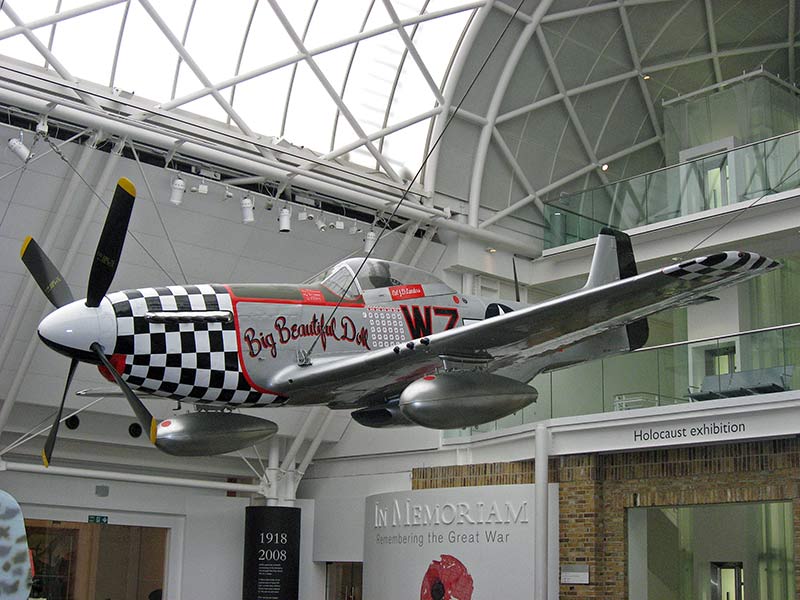
“A68-192”. In the photograph A68-192 is in the livery of 472218 "Big Beautiful Doll" as
flown by Colonel John D. Landers the Commanding Officer of the 78th
Fighter Group who was based at Duxford during 1944 to 1945.
On the 9th April 2011
A68-192 left the UK for Bremgarten, Germany, to join the new owners at the Air
Fighter Academy.
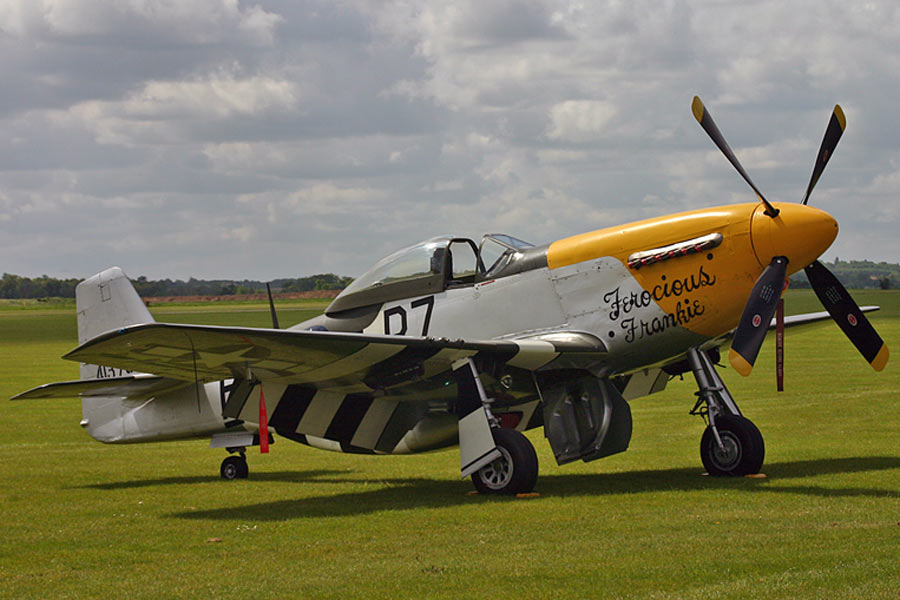


North American P-51D Mustang (44-73149) [@ RAF Duxford]
The Mustang III was the RAF’s designation for the Merlin powered P-51B (308 built) and P-51C (636 built). Originally the RAF had ordered 1000 P-51Bs and the first aircraft were delivered in February 1944 to 19 and 65 Squadrons, the first 36 aircraft having been diverted to the USAAF 8th Fighter Command to alleviate the critical shortage of escort fighters. Squadrons 19 and 65 formed apart of 122 Wing which at first concentrated on bomber escort and often accompanied American 8th Air Force bombers on raids over Germany while the USAAF built up its own Mustang units. Eventually twenty two RAF squadrons were equipped with this variant. This variant was identical to the American variant except that the original greenhouse cockpit canopies were replaced with Malcolm hoods, as used in the Supermarine Spitfire. The canopy was manufactured by the Malcolm & Co and hence its name. The Plexiglas bubble canopy bulged outwards and this gave the pilot a better view to the rear. A number of Malcolm hoods found their way into US service and it is reported that some US pilots preferred the Malcolm hood to the bubble canopy adopted for the P-51D, presumably because it retained the original rear fuselage of the Mustang which contributed to the aircraft’s stability in flight.
44-73149 was
built by the North American Aviation Factory at Inglewood, California, and
delivered to the USAAF on the 27th February 1945. Shipped via
Liverpool docks 73149 arrived a month later to the 357th Fighter
Group based at RAF Leiston, Suffolk. This group flew its last UK based mission,
an escort operation, on 25th April 1945 and moved to Neubiberg near
Munich, Germany, on the 21st July 1945. For the next eleven months
73149 served with a number of US training units in the UK before returning to
Newark, New Jersey, in January 1946 for storage. On the 7th June 1947
73149 became a part of the first delivery batch to the Royal Canadian Air Force
and assigned 9568. Initially assigned to the Defence Research Establishment at
Suffield, Alberta, 73149 was finally sold for private use on the 25th
February 1957 and entered unconverted to outside storage at RCAF Carberry,
Manitoba, until 1962. After a number of private owners 73149 eventually returned
to the UK during April 1980 when leased to The Fighter Collection. Based at RAF
Duxford 73149 was re-sprayed as USAAF 63221and marked as
“Candyman” /
“Moose” (the name on one side of the fuselage and the
Moose’s head on the other). After being involved in the
filming of the
“Memphis
Belle” 73149 was given a complete overall in 1989, which
included the removal from the fuselage the rear fuel tank. The modification
allowed the fitting of a
“dickey” seat which in 1944 allowed General Eisenhower to
survey the D-Day beaches from the back of a Mustang. On the 18th
August 1999 73149 was acquired by The Old Flying Machine Company, RAF Duxford,
and repainted in 2002 as 44-13704
“Ferocious
Frankie” of the 374th Fighter Squadron, 361st
Fighter Group which operated from RAF Bottisham, Cambridgeshire, RAF Little
Walden, Cambridgeshire, and Chievres, Belgium. The 361st Fighter
Group entered combat with the Republic
P-47 Thunderbolt on the 21st January 1944 and had converted to
P-51's during May 1944 before moving to RAF Little Walden during September 1944. The original 44-13704 "Ferocious Frankie" survived the war and is on display at
the United States Air Force Museum at Robins AFB, Georgia.

North American P-51D Mustang (44-73979) [@ Imperial War Museum]
Built at the North
American Aviation Factory at Inglewood 44-73979 was
delivered second hand to the Royal Canadian Air Force as 9246 on the 6th
December 1950. Six months and three squadrons (416F Squadron based at Uplands
Ottawa, 402 Squadron (Auxiliary) based at Stevenson Field, Winnipeg, and 420
Squadron (Auxiliary) based at Crumlin, Ontario) later 44-73979 suffered a major
accident which cut short the operational career. Grounded after this accident on
the 16th May 1951 73979 became an instructional airframe on the 10th
May 1955 at the College Militaire Royale, St. Jean, Quebec. Finally Struck of
Charge during 1960 to become a gate guardian at RCAF St. Jean, Quebec, until
1968 when 73979
was purchased by the Imperial War Museum, RAF Duxford, and shipped to the
UK. Restored to static display condition by October 1973 73979 was then
transferred to the Imperial War Museum, Lambeth, in 1989.
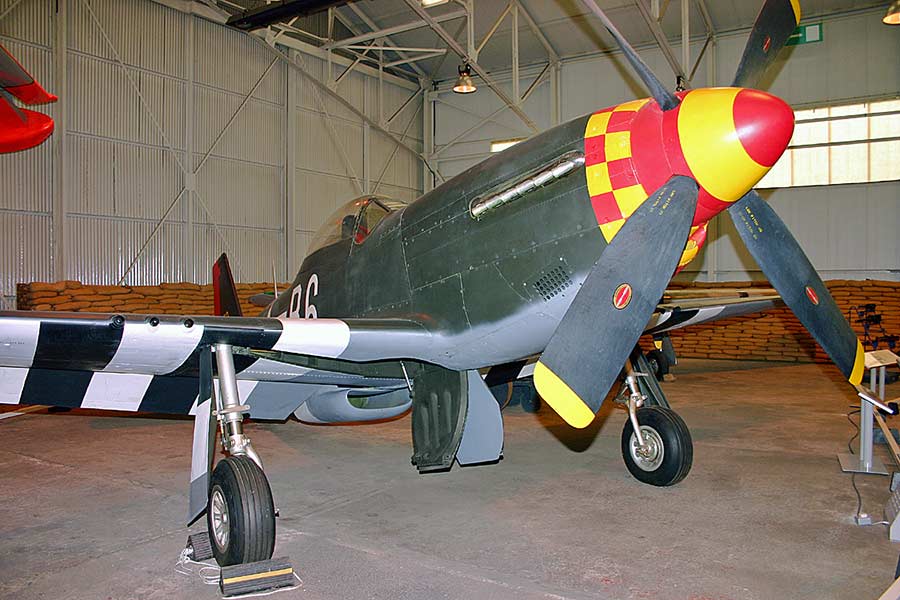

North American P-51D Mustang (44-73415) [@ RAF Cosford]
Built at the North American
Aviation Factory at Inglewood 73415 was delivered to the USAAF on the 14th
March 1945 and designated to the Third Air Force.
Probably used for training purposes 73415 was placed into storage and
designated surplus to requirements on the 13th September 1950 and
subsequently taken on charge by the Royal Canadian Air Forces as 9289 on the 8th
February 1951. Assigned to the Air Defence Command and Tactical Air
Command, 73415 also served with 403 (Auxiliary)Squadron , a tactical fighter
squadron, based at Calgary, Alberta. Placed
into storage after the withdrawal of the Mustang from RCAF service 73415 was
Struck off Charge on the 14th August 1959 and sold to the private
market. Rebuilt and modified as a racer after a major accident on the 19th
March 1977 at the Olympia Municipal Airport. Presumably the fuselage had been
modified at some stage and a “dickey” seat fitted since in the crash both the
pilot and passenger were killed. The subsequent modified aircraft is still
flying as "Voodoo" with serial number 44-73415. The remains of the fuselage
together with other parts from a former Indonesian Air Force P-51D were
initially rebuilt by Kal Aero Services on behalf of the Eagle Squadron
Association. Flown to RAF Lyneham, Wiltshire, in a RAF Hercules on the 13th
February 1989 and transferred to RAF Halton, Buckinghamshire where 73415 was
officially handed over on the 20th April 1989. Unfortunately the
restoration work was considered not to be of an exhibition standard and so a
second rebuilt was started with a dismantling of the 73415 in June 1989. With
restoration completed in early 1990 73415 was placed on display at RAF Halton
before being transferred to RAF Hendon for display during the early part of
1991. With the arrival of 44-74409 “Donald Duck” 73415 was transferred to RAF
Cosford on the 14th July 2003. In the photograph 73415 in the livery
of the 8th United States Army Air Force, 357th Fighter
Group, 363rd Fighter Squadron which was based at Leiston, Suffolk. This unit was the first Mustang Group assigned to the 8th Air Force
and the markings on 73415 are those of Flt Lt Cleland, RNZAF, one of the few
Commonwealth pilots who did an exchange posting with the Americans.

North American P-51D Mustang (44-84847) [@ RAF Duxford]
Delivered to U.S. Army Air Force 44-84847 was one of the last Mustangs to be
constructed at North American Aviation’s Dallas factory. Although built
too late for WW2 there some evidence that 44-84847 did serve with the 45th
Tactical Reconnaissance Squadron (TRS) at Kimpo, South Korea, during the Korean
War. With the replacement of the TRS Mustang with the reconnaissance
Lockheed RF-80 Shooting Star jet from late 1951 44-84847 was consequently
shipped back to the US and served with the Air National Guard until 1956.
Probably placed into storage until the late 1990’s 44-84847 underwent
restorations and was finally restored to the two-seat TF-51D standard.
44-84847 flew again on the 25th March 2007 and was then fitted with
external drop tanks and flew across the Atlantic arriving at RAF Duxford on the
4th July 2007. In the photograph is in the livery of Mustang
44-14561, Miss Velma, flown by Capt Frank Birtciel of the 55th
Fighter Group. Interestingly the 55th Fighter Group moved from
the USA to RAF Wittering during August/September 1943 to become the first P-38
Lightning Group to go fully operational from the UK. On 16 April 1944 the
group moved to RAF Wormingford and reequipped with P-51 mustangs during
July 1944 and continued their primary task of escorting
Boeing B-17 "Fortress" and
Consolidated B-24 "Liberator" bombers.
The Mustang was useful against the Fieseler Fi 103 (V1 flying bomb). In fact about half of the RAF’s Mustang equipped squadrons were redeployed to Southern England after D-Day to deal with the treat. Using 150 octane fuel the Mustang was fast enough to catch the V1 and was operated alongside the shorter range Spitfire and Hawker Tempest. From late September 1944 RAF Bomber Command resumed daylight bombing operations over Germany with the result that the RAF’s Mustangs found themselves operating as long range escort fighters for Avro Lancaster bombers
.jpg)
+1.jpg)
Only 309 Squadron flew both the Allison and Merlin powered
Mustangs as the two aircraft were not readily interchangeable nor could they
easily perform each other’s duties. By the end of WW2 only 26 Squadron were
still using the Mustang 1. Having retro-equipped shortly after D-Day from the
Supermarine Spitfire the type was used
from December 1944 to carry out low level reconnaissance over the Netherlands
for V2 rocket sites. The final Mustangs were retired from RAF service in 1947.


North American P-51D Mustang (44-63871) [@ Musée de l'Air et de l'Espace, Paris - Le Bourget]
44-63871 was built by the North American Aviation Factory at Inglewood,
California, and delivered to the USAAF on the 5th December 1944. Intended for the use by the 8th Air Force
63871 arrived by sea to the UK in February 1945. However 63871 was sold to the
Swedish Air Force
(SAF),
ferried by American pilots to Sweden in April 1945, and assigned to the Kungl. Upplands Flygflottilj F16 which was based in Uppsala. Entering service under the
designation J26 (26039), 63871 remained in service until sold to the Israeli Air
Force (IAF)
in 1952. One of 25 Mustangs bought from the SAF
63871 entered service with 101 Squadron in February 1953 as an addition to the
Spitfire Mk IX. During the early 1950s
the IAF began arming itself with jet fighters such as the
Gloster Meteor and so the
remaining Mustangs
were placed
into storage during early 1956, however, international circumstances soon
dictated the return of the Mustang when in late October 1956 the Suez Crisis
broke out. Given
the
long operational range
of
the Mustang
the type was
tasked with destruction of Egyptian fighters and bombers at distant airfields,
some even beyond the Suez Canal in mainland Africa. A total of 48 Mustangs were
in
the
operation with 63871 being involved with 105 Squadron. With the disbandment of
105 Squadron in late November 1956 63871, with the remaining Mustangs, were
transferred to 116 Squadron. 116 Squadron was the last squadron to operate the
type and the Mustang remained in front line service until 116 was placed in
reserve during the latter part of 1958. The Squadron’s
primary role was to instruct new pilots. 636871 then entered the private
market and eventually entered the museum in 1975.
By 1944 the Australian government had
made the decision to replace its ageing P-40 and Boomerang fighters with the
North American P-51 Mustang. Initially one hundred P-51D's were shipped in
kit form from the USA to be assembled by The Commonwealth Aircraft Corporation (CAC).
Designated CA-17 Mustang Mk 20, eighty were completed with twenty kits being
kept for spares. These were then followed by one hundred P-51K's shipped
directly from the US. In 1946 CAC were licensed to build 170 of the P-51D
variant as the CA-18 Mustang Mk. 21, Mk.22 and Mk.23. The Mk.21 and Mk.22
used the American-built Packard V-1650-3 or V-1650-7 (Merlin 68) while a Rolls
Royce Merlin 66 or Merlin 70 engine powered the Mk.23. Only 120 were in
fact built.

North American P-51D Mustang (A68-170) [@ Royal Australian Air Force Museum]
Built by Commonwealth Aircraft Corporation (CAC) at Melbourne, Victoria, and
delivered into RAAF service on the 23rd February 1950 as A68-170, a
Mustang Mk 23. Placed directly into storage with 1 Aircraft Depot (AD) based at
RAAF Tocumwal, NSW. 1 AD was a maintenance unit of the RAAF. A68-170
was then issued to 78 Wing 20th July 1950 based at RAAF Williamtown
NSW. The Wing, comprising 75, 76, and 478 Squadrons and 114 MFCU, had
reformed during January 1949.
Allocated Mustangs and CAC Wirraways, the Wing also became the first to be
equipped with jets when it received, leased from the RAF,
de Havilland Vampire F.30
fighters between 1949 and 1951. Following repair from a belly landing at
RAAF Williamtown on the 30th September 1951 A68-170 was transferred
to 2 Operational Training Unit (OTU) on the 4th April 1952. 2
OUT had reformed on the 1st March 1952 at RAAF Williamtown to convert
RAAF pilots to jet aircraft and train them for fighter operations.
Initially equipped with Wirraways, Mustangs and Vampires the Unit ceased to
operate the Mustangs during the following October. Consequently A68-170
was transferred 23 (City of Brisbane) Squadron on the 2nd November.
The Squadron had re-formed at RAAF Archerfield, Queensland, on the 1st
April 1948 as a Citizen Air Force Squadron equipped with Mustangs and Tiger Moth
trainers. During 1955 the Squadron started to be reequipped with the
de Havilland Vampire. On the 12th March 1956 A68-170
was placed into storage with 3 AD based at RAAF Amberley, Queensland, until the
7th March 1959 when A68-170 was transferred to the Queensland Flight
of the Air Training Corps as an instructional trainer. A68-170 arrived at
the RAAF Museum during September 1970 in a dismantled state. Following
restoration A68-170 was placed on static display at the museum until 1990.
Following full restoration A68-170 flew again for the first time on the 17th
February 1999. Unfortunately during February 2012 metal was found in the
oil screens of the Merlin engine and so A68-170 has been grounded indefinitely.
In the photograph A68-170 is in the livery of RAAF Mustang A68-750. This
P-51D Mustang was built by North American Aviation and assigned the USAAF serial
44-84489. Disassembled and shipped to Australia, A68-750 was issued to 77
Squadron on the 12th November 1945 and operated in Japan at Bofu, a
former kamikaze base. Returning to Australia during November 1948 A68-750
was transferred to 78 Wing based at RAAF Williamtown on the 1st December
1948 before going to the School of Land/Air Warfare also based at RAAF
Williamtown on the 30th November 1950. From the 15th
March 1951 A68-750 was used for components and as a target until Struck off
Charge on the 1st April 1952. The remains of A68-750 are stored
in California USA pending restoration.


North American P-51D Mustang (A68-105) [@ Royal Australian Air Force Museum]
Built by CAC at Melbourne, Victoria, and delivered into RAAF service on 11th November 1947 as A68-105, a Mustang Mk 21. Placed into storage on the 14th December 1955 at RAAF Tocumwal, NSW, and Struck off Charge on the 23rd April 1958 at RAAF Tocumwal and sold on the private market. A number of different owners and museum appearances followed including a loan to the RAAF Museum at Point Cook, Victoria, from 1977 to 1990. From 1995 to 1999 A68-105 was restored to an airworthy condition with the first flight-taking place on the 18th December 1998. In the photographs A68-105 is in the livery Squadron Leader P.M.Nash the CO of 3 Squadron RAAF and represents the first P-51K operated by 3 Squadron in North Italy during late November 1944. [The photographs of A68-105 are by the kind permission of Alf Batchelder of the RAAF Museum]

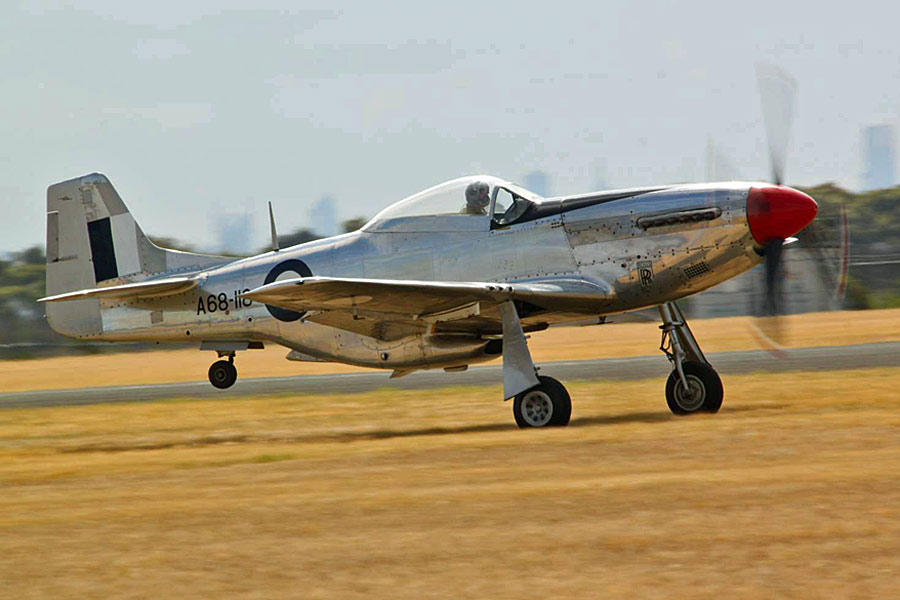
North American P-51D Mustang (A68-118) [@ Royal Australian Air Force Museum]
Built by CAC at Melbourne, Victoria, and delivered into RAAF service on the 10th May 1948 as A68-118, a Mustang Mk 21. Originally issued to I Aircraft Depot (1 AD) and then transferred to 76 Squadron of 78 Wing on the 11th August 1949. 1 AD was a maintenance unit of the RAAF. Formed in July 1921 at RAAF Point Cook, Victoria, the unit moved to the nearby RAAF Laverton in March 1926. The Wing, comprising 75, 76, and 478 Squadrons and 114 MFCU, had reformed during January 1949. Allocated Mustangs and CAC Wirraways, the Wing also became the first to equip with jets when it received the de Havilland Vampire F.30 fighter and later the de Havilland Vampire FB.9, leased from the RAF. On the 18th May 1950 A68-118 was damaged in an in-flight collision and returned to CAC for repair. Upon return A68-118 was placed into storage then Struck off Charge during April 1958 and sold on the private market. Following an emergency landing on the 6th August 1960, when a coolant line broke, A68-118 was placed into open storage. From 1973 to 1978 A68-118 was loaned to the Camden Museum of Aviation, NSW. Eventually restored to an airworthy condition A68-118 flew again on the 19th April 1981. [The photographs of A68-1118 are by the kind permission of Alf Batchelder of the RAAF Museum]
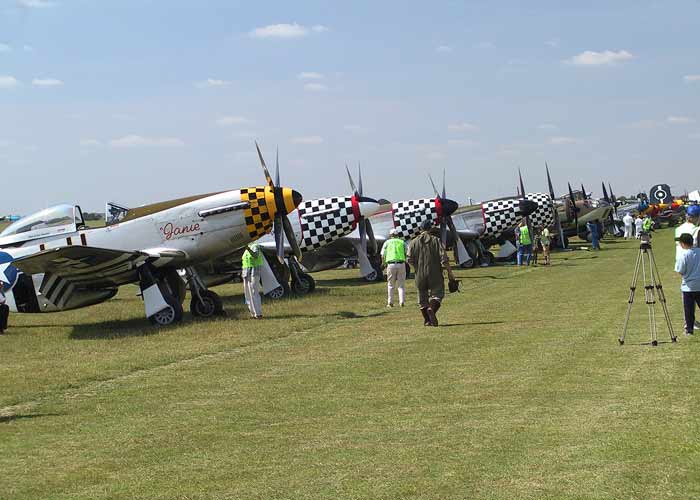
North American P-51D Mustangs [@ RAF Duxford]

